
A string of drone attacks on at least seven cargo vessels in the Black Sea this month, off the coasts of NATO members Romania and Bulgaria, has some members of the alliance wondering if Russian President Vladimir Putin is seeking escalation to test their support for Ukraine in its war against Moscow's full-scale invasion.
The attacks in the two countries' exclusive economic zones threaten a global shipping route and have left two people dead, with at least 25 still missing. They also run the risk of drawing other countries directly into the war for Ukraine.
Throughout the war, Russia has repeatedly bombarded Ukraine's Black Sea and Danube river ports, leaving Kyiv increasingly reliant on alternative routes to get its grain exports to markets in Africa and the Middle East. Russian drones have repeatedly violated Romanian airspace near some of Ukraine's Danube ports.
In the latest incidents, fires broke out on two ships struck by drones Wednesday and Thursday, one in Romania's territorial waters.
Earlier this month, sea and aerial drones attacked two other commercial vessels in Bulgaria's exclusive economic zone. A Togo-flagged ship sank with no sign of the 12 sailors reported on board, while a Bulgarian ferry evacuated 18 crew members from a Palau-flagged vessel that was damaged.
A day earlier, a Turkish-owned cargo ship carrying corn caught fire following a drone attack and later sank off the coast of Romania. Two people died and 11 crew members were rescued.
Ukrainian President Volodymyr Zelenskyy described the attack as “a horrific strike by two Russian drones on a civilian vessel” in neutral waters.
Russia's ambassador in Sofia, Bulgaria, said she didn't have any information from the Russian defense ministry.
The Black Sea drone incidents in October are just the latest in a long string of drone airspace incursions to rock Romania and other NATO members since Moscow launched its full-scale invasion of Ukraine. While most have come from Russia, Ukrainian drones have also crossed borders.
In August, Romania deployed two F-16 fighter jets to destroy a naval drone that was reportedly carrying explosives and was spotted near a major Black Sea gas project, a decision that Acting Defence Minister Miruta said was made to “protect the lives of the several hundred people” working on the gas platform.
A source in Romania's defence sector, who was not authorized to speak publicly about the incidents, told The Associated Press that the attacks are designed to hurt Ukraine economically and that “Romania is not the target right now.”
“All summer we've been hunting all kinds of (drone) debris, water drones, sea drones, air drones, debris in the water, on the beaches,” they said. “If this continues … someone should do something about that.”
The source added they have heard Turkey “would like to summon all the riparian (Black Sea) states to plan a mission to escort these convoys” through a militarised safe corridor.
“I'm not sure about Turkish, but our Romanian vessels don't have anti-air defence systems to protect against drones,” they said. “That would be a high risk for the Navy, for military vessels to escort this.”
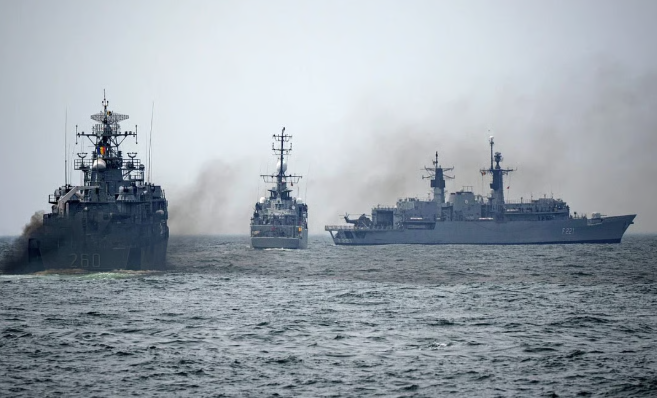
In July, Romania, Bulgaria, and Turkey expanded the Black Sea Mine Countermeasures Task Force naval pact to “expand the missions to the protection of critical submarine infrastructure,” according to Romania's defence ministry.
It would include, it said, a permanent naval presence in Romania's exclusive economic zone.
“The (premium) for the risk is increasing, ... everyone that wants to come to Constanta, let's say from Turkey, from the Bosphorus Strait and across that area, will have a (premium) on insurance costs,” he said.
He added his main concern is a “serious incident” occurring at or near Constanta. In June, a Ukrainian maritime drone exploded at the port, and three others nearby.
“It's a matter of time,” he said. - AP